
Shadow AI happens when employees use unapproved consumer AI tools to get work done faster. Without clear rules and proper guardrails, sensitive customer data and company intellectual property can end up in public AI models, exposing small businesses to severe privacy leaks, regulatory fines, and security breaches.
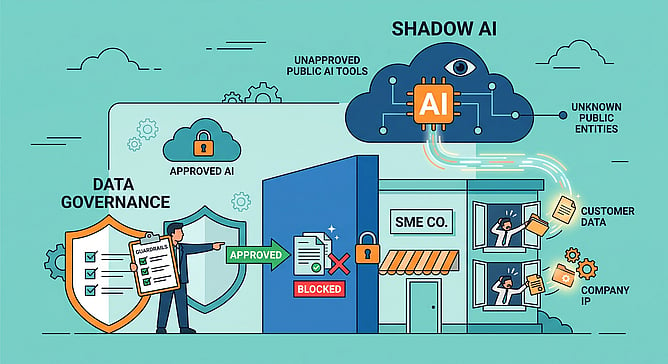
Key SME Risk Areas
Data Exposure
Public training models: Pasting code, client files, or internal strategy into free tools can make that data part of the AI’s public training dataset.
Customer confidentiality: Violating non-disclosure agreements or privacy laws by exposing sensitive client details without consent.
Compliance and Legal
Regulatory non-compliance: Violating local privacy standards when personal data is processed by unvetted third-party software.
IP loss: Unclear ownership terms on consumer platforms can compromise proprietary algorithms or copyrighted content.
Operational Vulnerabilities
Inaccurate outputs: Staff relying on unverified AI responses without fact-checking or quality control.
Zero audit trail: No visibility into which AI tools are accessing company data or what information is leaving the network.
Risk vs Protection Strategy
Shadow AI Risks: Unvetted tools, public data training, client privacy breaches, zero visibility.
Governance Safeguards: Approved tool lists, clear usage policies, opting out of data training, team training.
Business Impact: Prevents data leaks, maintains client trust, and ensures compliance without stopping productivity.
SME Action Steps
Create a clear, one-page AI usage policy outlining acceptable and prohibited uses.
Provide team access to paid enterprise or privacy-compliant AI accounts that do not train on company data.
Conduct brief staff training on identifying sensitive data before using AI tools.
Block unapproved consumer AI sites on company networks and devices.