
Disaster Recovery for Auckland Businesses
Is Your Auckland Business Prepared for a Sudden Data Disaster?
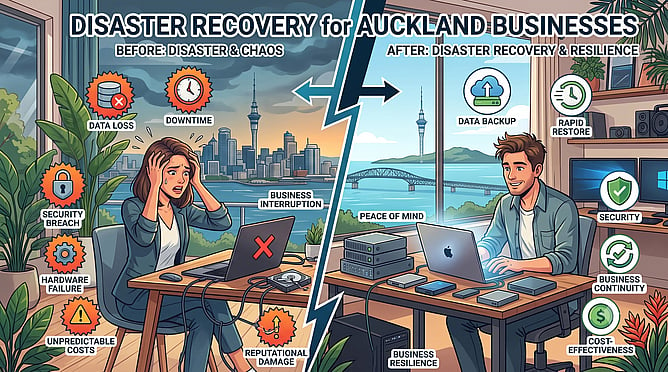
Imagine arriving at your office in East Tamaki or opening your laptop in Central Auckland tomorrow morning, only to find that your primary server has failed, or a sudden power surge has wiped out your local hard drives. For many small-to-medium businesses, this scenario is not just a minor inconvenience; it is a critical emergency that can halt operations for days.
Hoping that hardware will never fail or that accidents won't happen is not a business strategy. Having a clear, tested disaster recovery plan is what separates businesses that bounce back in minutes from those that face devastating financial losses.
The Real Cost of Business Downtime
When technology fails, the financial impact accumulates much faster than most business owners realise. You are not just paying for a technician to repair the immediate physical fault. You are paying for every single hour that your employees sit idle because they cannot access client files, send emails, or process financial transactions.
If your systems remain offline for days, your customer service levels drop, and frustrated clients may begin looking to your competitors. A solid backup and recovery strategy ensures your business remains resilient no matter what happens.
The Three Core Pillars of a Reliable Recovery Plan
1. The 3-2-1 Backup Strategy
A reliable backup strategy requires variety. Industry best practices recommend keeping at least three copies of your data. Store two copies on different physical media types, such as an internal hard drive and a local external backup drive. Crucially, ensure the third copy is stored completely off-site in a secure cloud environment. If a physical event like a fire or flood damages your office hardware, your cloud backup ensures your data remains perfectly safe.
2. Regular and Automated Backups
Relying on an employee to manually plug in an external drive and copy files every Friday afternoon is a major vulnerability. People get busy, variables are forgotten, and backups get skipped. Your data backup systems must be entirely automated to run quietly in the background every single day, ensuring you never lose more than a few hours of work if a failure occurs.
3. Routine Recovery Drills
A backup file is only useful if it actually works when you need to restore it. Over time, backup files can become corrupted, or software settings can drift without anyone noticing. It is vital to perform routine restoration tests at least once every few months. Intentionally restoring a selection of random files proves that your systems are working correctly and guarantees you can recover your data quickly during a real emergency.
Partner with BillyTec to Secure Your Business Continuity
Building a bulletproof disaster recovery framework requires technical expertise and continuous monitoring. You do not have to figure it out on your own.
At BillyTec, we specialise in designing and implementing automated cloud backup systems and comprehensive disaster recovery plans for businesses across the Auckland region. We analyse your specific operational needs, set up secure off-site data replication, and carry out regular testing so you can rest easy knowing your business secrets are completely safe.
Want to protect your business data from hardware failures & unexpected disasters?
Contact BillyTec today for reliable backup solutions and professional IT support in Auckland.